by Amparo Arrospide
Including an interview with Amparo Arrospide by Sara L Russell, plus additional tributes by David Michael Jackson, Loukia Borrell and Sara L Russell plus a special tribute by Richard Vallance.
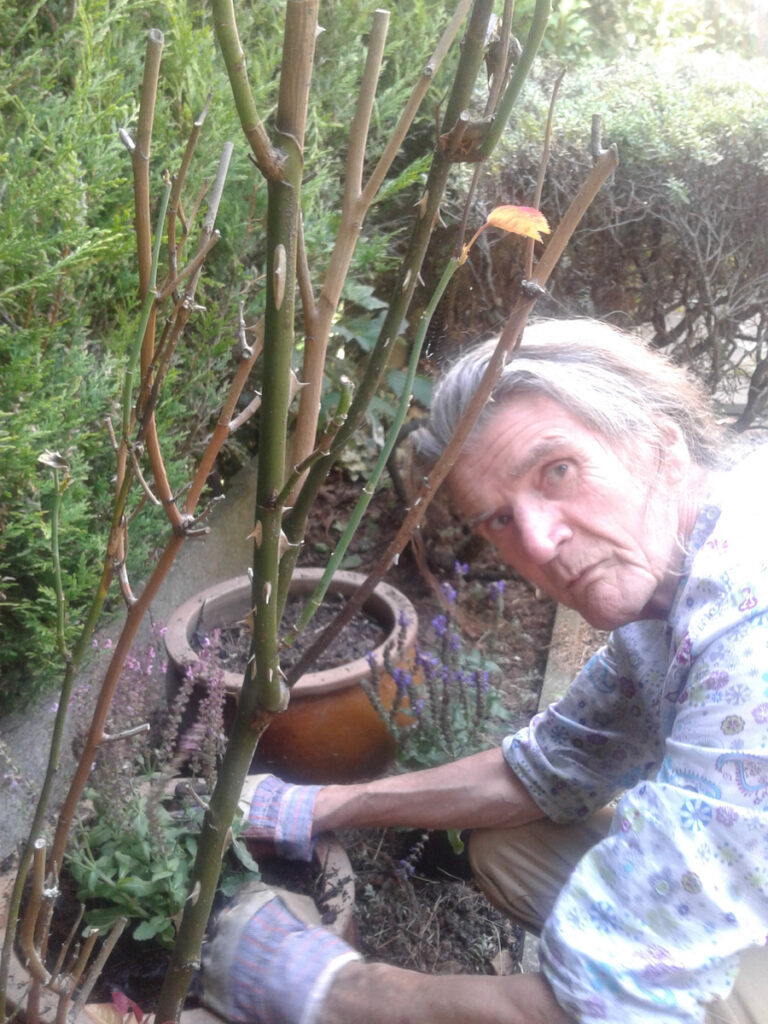
Sara: Firstly, Amparo, may I say how sorry I am for your loss, and how we will all miss Robin, whose contributions to both poetry and translation spans decades of dedicated work.
How did you and Robin first meet?
Amparo: I met Robin in 1982 at the University of Manchester, where he was studying Philosophy and Comparative Religions. He had come from Pakistan, where he had lived for eight years in Karachi and Lahore, exploring its valleys and mountain ranges. His close friend at Punjab University was Kazi Javed, a free thinker passionate about philosophy, history and the contemporary world, and a writer in Urdu. In Pakistan, Robin had studied Sufism, the mystical poetry of Jalal-U-Din Rumi and Ibn Arabi, specializing in comparing medieval Islamic philosophy with European scholasticism.
I had arrived to Manchester on a work grant as Spanish language assistant. We met in the postgraduate club and started dating. I was fascinated by his eloquence and his thirst for knowledge—we shared the latter. We became a couple, and he encouraged me to pursue a master’s degree in Literature. Three years later we traveled to Spain, where we stayed for a long time. Robin worked as an English language teacher in corporations and with individual students.
Our son was born in Madrid in 1988; there were moves, job changes, and lifestyle shifts. At the Ateneo of Salamanca, we participated in literary gatherings, recitals, and publications. And then in Madrid, at the Complutense University, Casa do Brasil, the Ateneo, in bilingual recitals in cafes and pubs with poets like Andrés Fisher, Mario Merlino, Yolanda Pérez Herreras… The world wide web arrived around that time, opening doors to the unknown.
Sara: Had Robin already studied Spanish when you met?
Amparo: When we met, Robin was already studying Spanish, improving once we moved to Spain. The relationship was even more fun then; we started translating ourselves and other poets. A gift for languages, entailing careful revisions of what had been read and said, due to the inevitable twists and turns of interpretation.
And speaking of translation, Poetry Life & Times was a later and crucial moment.
Sara: What are a couple of your favourites of Robin’s poems?
Amparo: “The Fan” and “Drumbeat”; both poems included in Rhythms of Existence, his last published book in India (2025, cyberwit.net).
Sara: Thank you Amparo. I have featured them below.
Drumbeat
asleep i find i dream your heartbeat in mine
& waking find i hear the pounding tom tom
a drumbeat reverberating over continents of time
before gods & goddesses came with their acclaim
of sun & moon which they cast to stone & tomb
& after the bomb that had pulverised us to a dust
as a shadow frame from where before we´d been
across the plains of existence i hear the pulsation
resonate the rhythm in yours & mine as the same
as asleep i find i dream your heartbeat in mine
& waking find the air upon my skin breathing
The Fan
a few short years
a few short days
a few short hours
a few short moments
you (?)
beyond the exalted reach
who are you now
beyond it all
beyond its silent call
the all in all
that totalises the now
yet fragments as a peacocks fan
sailing beyond reach
beyond touch
like a rare butterfly in a jar
the prosaic word burns within a tower
whilst the rest of the world gives
and who is the world
i ask of the flower
me she sings
i am the daughter
i am the hour
Sara: I really like Robin’s epic poetry recital of your translation of Carmen Crespo‘s epic poem “Tesserae“, which is on the YouTube link below. How did Robin get into making poetry videos?
Amparo: We began recording audio poems while Robin composed “Moon, Selected Audio Textual Poems”, which was finally published in 2020. In “Moon”, each poem is preceded by a QR code, enabling simultaneous reading and hearing of his resonant and almost hypnotic voice. He continued composing audiovisual poems with background music, participating in Transforming with Poetry, the online recitals coordinated by Antonio Martínez Arboleda. With Antonio, Robin presented Guadalupe Grande‘s “La llave de niebla” / Key of Mist at Casa Colombiana in Leeds, with Antonio reading the original poems in Spanish and Robin our translations. Together we had also translated Carmen Crespo’s “Teselas” / Tesserae. I would draft each poem in English, which we would then refine together, with Robin always adding the final touch, until the authors gave their approval.
Sara: Thank you for the interview, Amparo.
Tributes to Robin Ouzman Hislop
“He was my love with marine eyes. I don´t have any doubt about the memory he leaves with me; someone as erudite as he was steadfast, as much a companion as he was a unique personality. And not someone who was merely his own, nor merely mine, but “truly yours” — because of his generosity with the poetry of others”.
– Amparo Arrospide
– David Michael Jackson
“Robin really understood a writer’s calling, this feeling of being born to connect ideas, feelings and experiences through writing. His extensive travels deepened his creativity, and he was generous with his time and talent, paving the way for writers to hone their talent and sharpen their minds. His absence will be felt for years to come.”
– Loukia Borrell
I will always be grateful to Robin Ouzman for his visionary poetry, his great choices of poets when he took over Poetry Life & Times from me as Editor, his sense of humour and his wisdom. He was a very innovative member of The YouTube poets; pushing boundaries and always producing memorable translations with his talented partner, Amparo Arrospide. He will always be sadly missed in the poetry community.
– Sara L Russell (pinkyandrexa)
In memory of Robin Ouzman Hislop, British poet on the stellar ascendent of the early third millennium
We are truly pleased to honour and celebrate lasting legacy of the poetry, life and times of Robin Ouzman Hislop (November 18, 1945 – January 6, 2026), one of Britain’s pre-eminent poets on the ascendent of the early third millennium, who sadly passed away at the age of 80 in the winter of 2025.
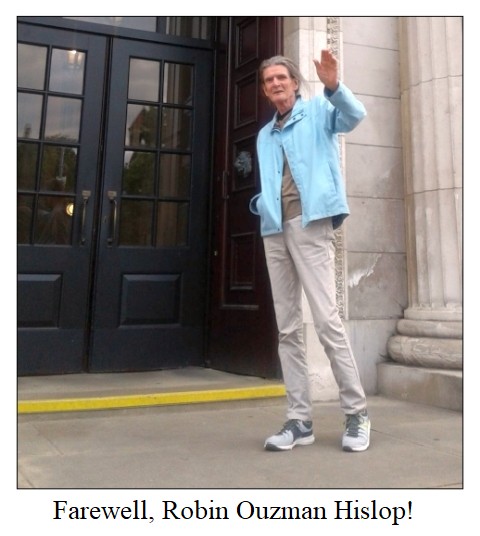
Honorifics accorded to Robin Ouzman Hislop:
“Robin is a philosopher, poet, published author and more. It has been my privilege to reap the benefits of this man’s knowledge on an array of subjects. He has extensive knowledge on mind/body philosophy, evolutionary theory & cosmology theory. A man ahead of his time. A true visionary and creative genius.
~ Janet Caldwell, who was COO at Inner Child Ltd, author of the Author Den’s award winning 5 degrees to separation.
“Robin is a brilliant writer and philosopher as well as a recognized poet. He is an editor and contributor for Poetry Life and Times – Poetry from the world, and other publications.”
~ David Michael Jackson, Web Publisher at Artvilla.com, Artvilla – Ezine of Poetry Music and Art
“Robin is a highly innovative and gifted poet, who excels in writing sonnets, blank verse and haiku, and in translating poetry from Spanish into English. His work is first-rate.”
~ Richard Vallance, Editor-in-Chief, The Phoenix Rising from the Ashes = Le Phénix renaissant de ses cendres. Victoria, B.C.: Friesen Press, 251 pp. ISBN 978-1-4602-1701-6 © 2013 (out-of-print) PDF accessible online at:
Poetry Life & Times and Robin Ouzman Hislop:
Poetry Life and Times – Poetry from the world was established by Sara Russell in 1998, in the form of a monthly bulletin of news of celebrated and rising poets, of their memorable poetry, and of the Vallance Review of famous poems (mostly sonnets) of the late nineteen nineties and the early third millennium. Its editorship was transferred in April 2006 to Robin Ouzman Hislop and his partner, Amparo Perez Arrospide, and they as a team further expanded the magazine to poets whose native language was not English (from Zimbabwe, India, Chile, Spain, and Latvia amongst others). The shift was also marked by a trend towards a more critical and politically minded collective voice. The magazine is currently being hosted by the poet David Michael Jackson.
Robin´s publications include After the cave, the comet , All the Babble of the Souk , Cartoon Molecules and Next Arrivals, collected poems, & Moon selected Audio Textual Poems available at amazon.com as well as translation of Guadalupe Grande´s La llave de niebla, as Key of Mist and Tesserae , a translation of Carmen Crespo´s Teselas. His latest Rhythms of Existence is available at amazon.com
Succinctly put, it is well nigh impossible to do true justice to the vast panoply of poetic oeuvres he has been inspired to pen since the early 2000s, particularly on these two poetry venues, Artvilla – Ezine of Poetry Music and Art and Poetry Life & Times. So rather than viewing some of his most memorable poems in their entirety, we are mindful to cite several telling passages to whet your appetite:
Excerpts from noteworthy poems by Robin Ouzman Hislop in Poetry Life & Times Robin Hislop – Poetry Life and Times, selected by Richard Vallance and Amparo Arróspide.
time a dimension that
ripples with its rhythms
into a pattern of events
transformed into entelechy
in eternal metamorphosis
a demiurge
where fury of fire flood quake drought
or rage of apocalypse
exploding skies creeping pestilence
or us between in a nebulous
symbiotic moment
where devils are angels & angels devils
as nature in its rags & glory roams
its own wilderness lost & found
as life flows on
in eternal metamorphosis
as the surge on the wave
breaks to spray
turbulence becomes a vortex
a twisted relationship
between gravity and entropy
symbiosis
do the spiral galaxies dream
here in the helix of my heart
on on on the vortex trembles
From Metamorphosis
*
wild cooing of doves in distant branches
beyond the curtain drawn window
in the darkened room
where he sits on the edge of the bed
frail & thin gently nodding to & fro
thinking progress be damned
nation states wear hoods
ghost riders in the sky stampede
the plains & piss in the oceans
the salmon from the rivers have gone
in what seas will they now spawn
& he is down by the riverside
down by the riverside where
he casts his line into its waters …
From Damn you all
*
forest feline fir purring
dusks dawns this wastrel man
his vagrant days that like tattered
rags clothe his face
as autumn leaves fall
we walk together now to listen talk
where both our persons are now
diminished
before the tempest of ice
& fire consumes us once more
& yet I say we will regain & you
will come again jaguar moon
forest feline purring your dawn dusk’s born
hawthorn & the rowan the red berries growing
a van flashes by our simulacra
i have nothing to offer you
but my blood in your music
From Jaguar Moon
*
the first line on the page thought to escape its life sentence
like an errant angel falling into the breach
a heavenly ape descended & disappeared into the waters
transfixed the statue wears the same mask as the crowd transfixed
heaven & hell are on the spin of a coin
blue whales’ melodies turned to shrieks are the ocean’s voice
& the iceman cometh to explain the glory of a name by which he would be forgotten
From The Triumph of the Left Hemisphere (ii)
*
it’s a play come what may
the talkie talk it’s off off
or blackboard chalk just as well
stork & baby but can’t tell
drive me crazy in fucking hell
that’s to begin off off off
can anyone say cloud into day
a poem’s itness is its it?
From The Hidden Variable
You may listen to this poem as read by Robin himself:
https://youtu.be/_bAK614UsJM?si=1r_AYvfwRo210W_f
*
Her face is as if a moon glazed over
with a less serene ceramic dust that in the end
after its perplexity contains its surety.
She draws her forefinger laterally across
under her eye lid in a smear
nor can you change the image of what you are
in the pupil of her eye.
Babble bodies blur
voices with their echoes down the street
sky high, prices fly
a bird song breaks, a splash charade.
From Africa North (i)
By day the olive tree green in the blue sky of the window
seems almost immortal enriched with the blood
it’s enriched, now at its roots.
Costa de la playa, white beehives in the sun, all money, no honey.
In the broken lights of the bazaar
the dusky eyes of the beggar sunk in their sockets
maze in crooked cul de sacs embargo amidst
the furls of silk that foil the flickering lantern niche.
In the gloaming a solitary reaper reaps its shadow.
Streets packs ravage carcasses
at dawn, the city wakes to the city’s obedience
to obey its disappearing shadows.
A ghost city of watchers
watched as shadows by a memory that has outlived them
now fragments in an admixture of old, new
amidst a junk yard of rubble
watcher shadows phased captive to their fading stories.
From Africa North (ii)
*
utumnal sludge trudge mush trudge mush
dear ape sweet ape good ape
O homo rapiens beautylovedeath
rhapsody in blue minor the trees
stark & bare don’t care
mush trudge sludge mush trudge sludge
swing low sweet swing low sweet
coming for to coming for to
depending on where of kith of kin of kinship
dear ape beauty ape love ape
death gape in the dark void sing
beautylovedeath beautylovedeath beautylovedeath
deathbeautylove deathbeautylove deathbeautylove
& so on in a hole to fall in fall in fall in
falling falling falling
From After the cave, the comet
You may listen to this poem as read by Robin himself:
https://youtu.be/I2tbaDX8htU?si=9TqOwMFc9wMSSHF2
*
Chuang Tze perched
on his usual precipice and reflected
on to suicide or not to suicide.
He recalled he had worn a dark suit
dark glasses, returned
on a crowded summer’s night to a past
whose memories
he could no longer remember
there he had sown his wild seed
what had they come to now
but the way of all nothingness.
There are those who maintain
creation is a purposeless drift
those who maintain its entelechy
can simulate a deity of divine attributes.
Chuang Tze rocked to, fro
would not such deities grow perplexed
about their state of affairs
traces of white fleece trailed
across that blue emptiness called the sky
thus in that fall
from that exalted simulation
believe they were immortal souls.
Chuang Tze said
Even the wind is flawed
as it speaks through the leaves of trees
the moment of history.
From The Split
You may listen to this poem as read by Robin himself:
https://youtu.be/3cnPeizAw-k?si=3UHjLN3Gw9O2jCAO
*
GOOD NEWS
New Study / People
eat at least 80,000
plastic particles a year
Story of the week
i rise from my 5 dollar a day
chez longe my 1.50 dollar
a day umbrella shade
to float on the see through sea
spitting out those same particles
washed inshore watching
brown bits of sewage dirt
through the corners of my eyes
( University of Victoria Canada
who led the research
other foods such as bread
processed products
meat dairy & vegetables
may well contain
just as much plastic)
cluster into filmy layers
to coagulate with algae
& mollusk on the rocks
that adorn the bay
& tilting my head
i look outward
to where the sun
will set on a distant isle.
From Nine more for the road
The Phoenix Rising from the Ashes = Le Phénix renaissant de ses cendres
Doubtless, one of Robin Ouzman Hislop’s most notable achievements was his active participation as the Associate Editor of chapter 3, pp.173-187 3, (14 pages) in the multilingual anthology of sonnets and rhymed verse, The Phoenix Rising from the Ashes = Le Phénix renaissant de ses cendres, published in print in December 2013. Although this anthology is out of print, no longer available for purchase on Amazon, the online PDF version of it is available for free on academia.edu, here: (99+) The Phoenix Rising from the Ashes sonnets in English, French, Spanish, German, Chinese and Farsi. We encourage you to download this remarkable multilingual anthology of sonnets of the early third millennium, in English (Chapter 1, pp. 1-140), en français (chapitre 2, pp. 141-170), sonetos en español (pp. 173-179) = sonnets in Spanish (translated into English, pp. 180-187), Chapter 4, Sonnets in Chinese (pp. 189-201) and Chapter 5, Sonnets, Formal Verse and Persian Ghazals in Translation (pp. 203-222). Here is Robin Ouzman Hislop’s mini-bio from this anthology (in his lifetime, as of 2013):
Robin Ouzman Hislop (UK), Co-editor of the 12 year running Webzine Poetry Life and Times, has made many appearances over the last years in the quarterly journals, Canadian Zen Haiku canadien, including In the Spotlight (Winter 2010) and Sonnetto Poesia. Recent publications in Voices without Borders Volume 1, Cold Mountain Review, Post Hoc, Uroborus Journal, 2011―2012 and The Poetic Bond II. He has recently completed a collection titled, The World at Large. Currently, he lives in Spain and engaged in poetry translation projects. (pg. 232)
Feel free to browse through this anthology at your leisure, reading any sonnet in passing that catches your eye or which is particularly appealing to you, but above all, we draw your marked attention to Chapter 3, sonetos en español (pp. 173-179) = sonnets in Spanish (translated into English, pp. 180-187), curated by Robin Ouzman Hislop, which serves as a clarion portal into sonnets in Spanish millennium, lending us remarkable insights into his multi-varied talents as a sonneteer dedicated to the world-wide propagation of sonnets in Spanish of the early third millennium. We are bold to affirm Robin Ouzman Hislop’s introductory synopsis and analysis of Spanish sonnets in this millennium. Notably, he has this to say:
Introduction to Spanish Sonnets and their Translations into English
(a warm debate held between Robin and Richard)
“Concerning the sonnet and its form, I’m not really a stickler. A poet in my view may wriggle through composing one with all manner of irregularities and the end result might be viciously splendid. But having said that, if you are going to pursue the conventional form to the letter and confine yourself to that tight pattern rigorously, you must be sure the poem makes it, meaning: it is not sufficient to achieve that exact rhyming pattern if by doing so the poem is a complete flop.”
Comment by Richard: “With respect to Robin Ouzman Hislop’s assertion “it is not sufficient to achieve that exact rhyming pattern if by doing so the poem is a complete flop”, this is at least one point on which I beg to differ. Why so? Simply because over the centuries from the Renaissance to the present, in English literature alone, and surely as well in French, Spanish, German and Russian literature (amongst other languages), thousands of splendid formal sonnets in strictly standardized rhythm and metre, as well as clearly defined rhyme, have been penned, amongst which we count some of the finest masterpieces of formal poetry of all time. So let’s not throw out the baby with the bathwater. Yes, Robin Ouzman Hislop has a perfect right to declaim that “to achieve that exact rhyming pattern if by doing so the poem is a complete flop.”, but it surely goes without saying that such complete flops have never stood the test of time, and for the most part, have thankfully never seen the light of day. But the same goes for blank and free verse sonnets in the vein that poets the likes of Robin Ouzman Hislop and countless others have composed over the centuries, where yet again such complete flops can never have stood the test of time, and likewise have never seen the light of day.”
Robin Ouzman Hislop goes on to say: “Better by far is the first recourse.” Again, I beg to differ. Better by far is neither the first course nor the second. Where it comes to splendid poetry, sublime sonnets, either course yields magnificent results. There is no golden nugget here. It is not a matter of strict, rhythmic, rhymed sonnets and verse versus blank or free verse sonnets. Literature, by which I mean, great literature, and indeed, great sonnets, cannot be parsed into two discreet compartments by mathematical, Boolean logic. Poetry is not logic, it never was, and never will be, thank heavens! So let us not quibble over which school wears the crown. Both do.
On the other hand, Robin Ouzman Hislop brings these telling insights into play, and here I dare say he is bang on the mark:
“As we all know the parable of the Persian carpet, where an error must be woven into its fabric. Again, in my opinion, the Latin languages excel in the sonnet form. … passim… Perhaps it lies in the nature of the lyrical medium, which in the Spanish vowel system is inflective and in English emphatic. So we count the syllables differently: the norm of a Spanish sonnet is endecasilabo metre, 11 syllables, as opposed to English iambic pentameter, 10 syllables. The Spanish sonnets below have either followed an endecasilabo rhyming pattern or an Alexandrian, 14 (correction, actually 12) syllable blank verse pattern. So, in my translations of these three experienced poets, whose sonnets are of considerable calibre, I had to decide whether I was going to aim for a loose but hopefully exotic translation, which would entail a line by line construction with perhaps some altered synonyms to give the sense.”
(pg. 180)
Here he seems to contradict himself, but may I stress, only seems to, insofar as the most prevalent form of the Spanish sonnet is in fact in rhymed verse, in endecasilabo metre, just as the prevailing form for the vast majority of English sonnets is standardized rhymed iambic pentameter. Here again, he appears to admit that several formalized Spanish sonnets he translates “are of considerable calibre”. To be sure. He also appears to concede, albeit reluctantly, that “I had to decide whether I was going to aim for a loose but hopefully exotic translation, which would entail a line by line construction with perhaps some altered synonyms to give the sense.” In other words, he is able to have it both ways, celebrating formal, rhymed and metred endecasilabo Spanish sonnets, which he presents online in their original, as just he should, while at the same time, carrying off successful translations into English blank and free verse. All the more power to him.
Here are some highlights formal or blank-verse sonnets in Spanish, some by other Spanish poets, characterizing not only sense of style, metre and rhythm, but indeed his remarkable poetic acumen:
Princeps Tenebrarum
Lamerán sus tobillos las sombras de la noche
cuando termine el baile, e hipnótico te mire:
le pides que te rasgue con la carne de un beso
y anhelarás su cuerpo, su cuerpo que no está.…
Belle de Nuit
Allí estabas, tan alta, muñón de algún antílope
colocado en el cielo, antílope de luz,
mientras abajo regodeábamos, rastreros,
tú, envuelta en velos, rememorabas la belleza.
(by Amparo Arróspide)
Translated into English:
Princeps Tenebrarum * (excerpt)
The shadows of the night will be caressing his ankles
when the dance ends and he stares at you hypnotically
and you ask him to tear you open with a carnal kiss,
whilst longing for his body, a body no longer there…
* Latin for “the prince of shadows”
Beautiful By Night (excerpt)
You were there so high, like the hind of some rare antelope,
placed aloft in a vaulted sky as a creature of light;
whilst we, down below, delighted in our vulgarities,
you, wrapped in veils, reminded us of the beautiful night.
He goes on to say:
“My own sonnet, It’s Not a Phantom from a Distant Past, is an experimental construct in blank verse, not as you would find in the traditional Spanish endecasilabo, as in Neruda, but in iambic pentameter, though it has been translated into endecasilabo by Amparo Arróspide and myself. Again, there is always a price in translation: the line “but only deepen where we’re conceived”, cannot be transferred even in reconstruction, although it is imperative to the sense of the poem. It has to be insinuated into the context in order to achieve the endecasilabo form, even in blank verse. Overall, it may be viewed as a sort of ghost poem, though its beginning starts out in apparent denial of that. The penultimate line uses the phrase “holographic horizon” and, although the allusion to surface applies, it is intended as a philosophical allusion as well as the theory of physics as expounded by exponents such as David Bohm and Leonard Susskind. The sense may be better appreciated from a quote used by Dorion Sagan in one of his poems:
In what sense ‘is there’ a star that exploded a thousand years ago, and that we see now?… it is to be noted that, according to the distinction between phenomenon and noumenon, everything visible—ourselves included—could be nothing but memory and phenomenalization, no less than stars that have exploded, and appeared precisely when they have ceased to be noumena. (Maurizio Ferraris)
It’s Not a Phantom from a Distant Past (excerpt)
What enters then in this frame’s perception,
alluring because it’s beyond approach,
that cheats memory and never lets it go,
a holographic cosmic horizon
or death always reminding us we die?
Burning on the Stiff Mast of her Bones (excerpt)
Her body lamed like fiery wings
burning on the stiff mast of her bones,
whilst the nights were rendered to waltzes
by the sweet tame words of her kisses.
Now her womb luctuates obsessive echoes,
echoes where once a life’s blood was lighten…
and that in the flesh of her day is frozen
now in her ruins, as the burden that weighs.
It was a female’s dream of its seed
of torrential moons upon the shores
lovingly healed the wounds of destiny.
She sows the word with its deed,
she loved with the love of spring waters,
drowning as thus her light and her way.
Translated by Robin Ouzman Hislop from Luis Fores’
“Quemando el duro mástil de sus huesos”
(all original poems in Spanish published at Poetry Life and Times)
Above all else, it is noteworthy that Robin Ouzman Hislop diverges from what we might assume to be the standard or normalized format for the sonnet in Spanish, which we would naturally expect to adhere to the standard tenets in the devolution of the sonnet form in English, namely, (a) the adherence to a strict rhythmic pattern in the deployment of the iambic pentameter and (b) equally strict adherence to the standard rhyme scheme of the sonnet genre in English = abab, cdcd, efef, gg, insofar as he asserts, on the contrary, that sonneteers of his persuasion are not to be bound by such formalized tenets, but who instead envision their primary aim, which is to impress us with the impact of their visceral, frequently kinetic and sometimes even emotionally and psychologically jarring eidetic imagery and tempo.
His approach to the normalization of the sonnet genre along these lines may well prove anathema to die-hard purists of the sonnet form who adhere to the much stricter tenets cited above, namely, strict rhythm and rhyme throughout, but I for one believe we should always keep an open mind, on the understanding that the merits of either school, rhythm and rhyme versus blank and free verse, speak volumes to the reader.
Regardless of whether “the poet” (in the widest sense of that term) is a formalist, insisting on precise rhythm and standardized rhyme or otherwise espouses the more elastic forms of blank and free verse (as does Robin Ouzman Hislop), we need only recall the immortal words of Percy Bysshe Shelley, in his masterpiece, A Defence of Poetry (1821, published posthumously in 1840), which lay out the principle tenets of lyric poetry from time immemorial in the sublime realm it uniquely occupies:
From Percy Bysshe Shelley, A Defence of Poetry:
Poetry, in a general sense, may be defined to be “the expression of the imagination”: and poetry is connate with the origin of man. Man is an instrument over which a series of external and internal impressions are driven, like the alternations of an ever-changing wind over an Æolian lyre, which move it by their motion to ever-changing melody. But there is a principle within the human being, and perhaps within all sentient beings, which acts otherwise than in the lyre, and produces not melody alone, but harmony, by an internal adjustment of the sounds or motions thus excited to the impressions which excite them.
Poets, according to the circumstances of the age and nation in which they appeared, were called, in the earlier epochs of the world, legislators, or prophets: a poet essentially comprises and unites both these characters. For he not only beholds intensely the present as it is, and discovers those laws according to which present things ought to be ordered, but he beholds the future in the present, and his thoughts are the germs of the flower and the fruit of latest time.
An observation of the regular mode of the recurrence of harmony in the language of poetical minds, together with its relation to music, produced metre, or a certain system of traditional forms of harmony and language. Yet it is by no means essential that a poet should accommodate his language to this traditional form, so that the harmony, which is its spirit, be observed. The practice is indeed convenient and popular, and to be preferred, especially in such composition as includes much action: but every great poet must inevitably innovate upon the example of his predecessors in the exact structure of his peculiar versification. (all italics mine)
Does Robin Ouzman Hislop echo Shelley’s sublime tenets? Indeed he does.
© by Richard Vallance, 2026, Editor-in-Chief, The Phoenix Rising from the Ashes = Le Phénix renaissant de ses cendres. Victoria, B.C.: Friesen Press, 251 pp. ISBN 978-1-4602-1701-6 © 2013 (out-of-print) PDF accessible free online at:
This is the final issue of Poetry Life & Times. The Perils of Norris can still be found at:
https://www.artvilla.com/plt/poetry-life-times/the-perils-of-norris-ai-cartoon-by-sara-l-russell/