Kyle Baker Art | Life Size Charcoal Drawings of People

Charcoal Drawing of shirt
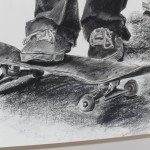
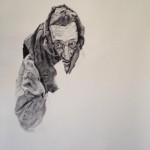
Kyle Baker is a “two dimensional artist out of Nashville, Tennessee. His charcoal drawings of people seem to capture an intimate look at the individual.
Charcoal drawing has an intimacy that started with cave drawings. Charcoal and stone were the expressions of man’s earliest age and every artist marvels at the cave drawings. Charcoal paintings date as far back as ca.23,000 BCE. Cultures utilized charcoal for art, camouflage, and in rites of passage. Art is made with the crudest of implements and charcoal drawings, as detailed as they are, are no different.

Caravaggio: His paintings combine a realistic observation of the human state, both physical and emotional, with a dramatic use of lighting.….. Wiki
All artists go for perfect form, shape, shade and color. They differ in the expression, the motif, in what they draw or paint. Some artists paint every day objects, fruit, landscapes or nature and, in those motifs try for some intangible something called beauty. Kyle Baker finds beauty in the homeless man, the guy on a skateboard, the wise old man on the street, the gutsy, the raw, the real. His drawings are visceral. We turn away from the homeless man. Kyle seems to find beauty in the “similarities and differences.”
His people have a dignity about them. His drawings are often life size. Kyle starts at the top of the page and the drawing is revealed downward. His hand is always resting on clean paper as he works down the page completing the forms as he goes.
I know Big Steve, or it seems I do, Kyle Baker’s  drawings of people in charcoal and graphite all seem like people I know, or have seen lately, on the street, in life. There is a universality to these drawings which, “combine a realistic observation of the human state.” Thank you Caravaggio. He didn’t say it, of course. Other people write the words because the artist thinks in “dramatic use of lighting”, like Caravaggio.
Our art is formed by our heroes. The artists study and emulate, then reach their own conclusions.

Here is an interview with Kyle Baker

What is the motivation for these drawings?
The motivations behind these drawings lies in the search to apprehend the subject.
Such drawing takes a lot of time. Why do you select the people you did?
I select the people I do because of the similarities I have with them which is then paralleled by the stark differences I have with them.
What are your goals as an artist.
As an artist, I hope to be able to work as a full time artist sometime in the near future.
Who are you artist heroes. Why?
I love the classical. I really like the contrast Caravaggio used in his pieces and I also thoroughly enjoy Van Gogh due to his story.
Since you draw so well, what do you think of “modern art”, abstract art?
I like modern and abstract art. I also think there is a sense of abstract in all art, including classical work.
What is the purpose of art.
The purpose of art is a hard question. I do not know . . . only the artist knows the exact purpose of their own art.
Does art have a social purpose? Does an artist have a duty?
Art can have a social purpose and a duty, but that lies in the hands of the artist.
When did you start to draw; was there a beginning event, artist or piece that knocked you down and started the journey?
I started drawing in high school. Barry Mcgee was one that I always liked. When I went to New York I remember being really in awe of a Chuck Close painting I experienced.
Where do you hope to be in 10 years.
In ten years, I hope to be happily married, live in a small house with a studio room, make art full time, and have enough money to travel where I want to go.

Kyle Baker’ s art is off to a good start. His first show of these drawings was at Hanna Lane Gallery

Caravaggio
The-Cardsharps-(I-Bari)


Billy Collins Poet – What Dogs Think!

billy-collins-2012-448

John Updike praised Collins for writing “lovely poems…Limpid, gently and consistently startling, more serious than they seem, they describe all the worlds that are and were and some others besides.” But Collins has offered a slightly different take on his appeal, admitting that his poetry is “suburban, it’s domestic, it’s middle class, and it’s sort of unashamedly that.”

[tubepress mode=”tag” tagValue=”Billy Collins Irish American Poet” resultsPerPage=”24″” resultCountCap=”24″ orderBy=”relevance” perPageSort=”viewCount” ]

editor@artvilla.com
robin@artvilla.com
www.facebook.com/PoetryLifeTimes
www.facebook.com/Artvilla.com

Two Demons Parse Your Fate | Poem by Ward Kelley

two demons
Two Demons Parse Your Fate

Two Demons Parse Your Fate
Ward Kelley

Two demons parse your fate, not always clear if they correctly consigned your stiff soul.

You expect at first to hear raucous glee
concerning your weakness and tendency
to exaggerate all your attributes . . .
yet you discern little joy in their tones.

Soon they both shake their heads over the skill
of your race to misjudge every action –
they wonder how humans unattended
to each other’s needs can yet produce Art
which will even make two unholies weep.

You hear them pronounce, “Those not actively
participating in the craziness
of this life are, at times, driven insanely Artful
by tranquility.” Hiding brings brooding.

You now remember how you came to Art.
Do artists – when they fall outside the norm –
always flee the silence of their own souls?

Soon the demons agree: you who misjudge
nearly everything will be perfect at
judging your own Art . . . although only once
you’re dead.

Two demons, both you.

Irish Voices. Paul Muldoon. Poet. Saoirse (Freedom)

paul-muldoon
 
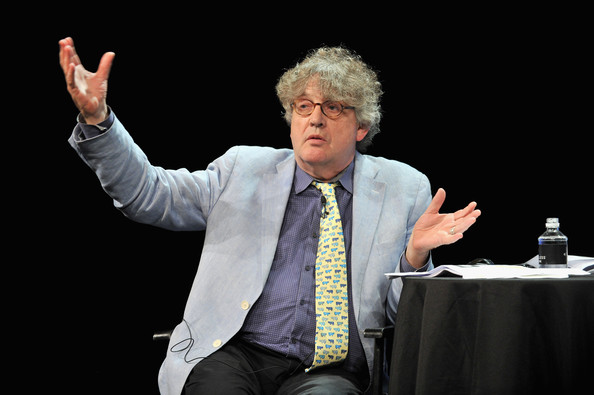
Paul Muldoon is one of Ireland’s leading contemporary poets. He was born in Portadown, County Armagh and raised near The Moy, in Northern Ireland. Muldoon’s work is full of paradox: playful but serious, elusive but direct, innovative but traditional. He uses traditional verse forms such as the sonnet, ballad, and dramatic monologue, but alters their length and basic structure, and uses rhyme and meter in new ways. His work is also notable for its layered use of conceit, allusion, and wit. The cryptic wordplay present in many poems has often been called Joycean, but Muldoon himself has cited lyric poets such as Frost, Thomas, and MacNeice as his major influences.
 
Muldoon is the youngest member of a group of Northern Irish poets—including Seamus Heaney, Michael Longley, and Derek Mahon—which gained prominence in the 1960s and 1970s. As a student at Queen’s University, Muldoon studied under Heaney, and refined his own analytical and critical skills in weekly discussions with other poets. In 1971, at the age of nineteen, Muldoon completed his first short collection, Knowing My Place. Two years later, he published New Weather (1973), his first widely reviewed volume of poetry. The book secured Muldoon’s place among Ireland’s finest writers and helped establish his reputation as an innovative new voice in English-language poetry.
 

[tubepress mode=”tag” tagValue=”Paul Muldoon Poet” resultsPerPage=”20″ orderBy=”relevance” perPageSort=”viewCount” ]

editor@artvilla.com
robin@artvilla.com
www.facebook.com/PoetryLifeTimes
www.facebook.com/Artvilla.com

Roger McGough Liverpool’s Poet

Roger McGough
 
McGough was born in Litherland, Lancashire, to the north of Liverpool, the city with which he is firmly associated, and was educated at the University of Hull at a time when Philip Larkin was the librarian there. Returning to Merseyside in the early 1960s, he worked as a teacher and, with John Gorman, organised arts events. After meeting Mike McGear the trio formed The Scaffold, working the Edinburgh Festival until they signed to Parlophone records in 1966. The group scored several hit records, reaching number one in the UK Singles Chart in 1968 with their version of “Lily The Pink”. McGough wrote the lyrics for many of the group’s songs and also recorded the musical comedy/poetry album McGough and McGear.
 
McGough was also responsible for much of the humorous dialogue in The Beatles’ animated film, Yellow Submarine, although he did not receive an on-screen credit. At about the same time a selection of his poems was published, along with work from Adrian Henri and Brian Patten, in a best-selling paperback volume of verse entitled The Mersey Sound, first published in 1967, revised in 1983 and again in 2007.
 
McGough won a Cholmondeley Award in 1998, and was awarded the CBE in June 2004. He holds an honorary MA from Nene College of Further Education;[citation needed] was awarded an honorary degree from Roehampton University in 2006; as well as an honorary doctorate from the University of Liverpool on 3 July 2006. He was Fellow of Poetry at Loughborough University (1973-5) and Honorary Professor at Thames Valley University (1993).
 

[tubepress mode=”tag” tagValue=”Roger McGough Liverpool Poet” resultsPerPage=”20″ orderBy=”relevance” perPageSort=”viewCount” ]